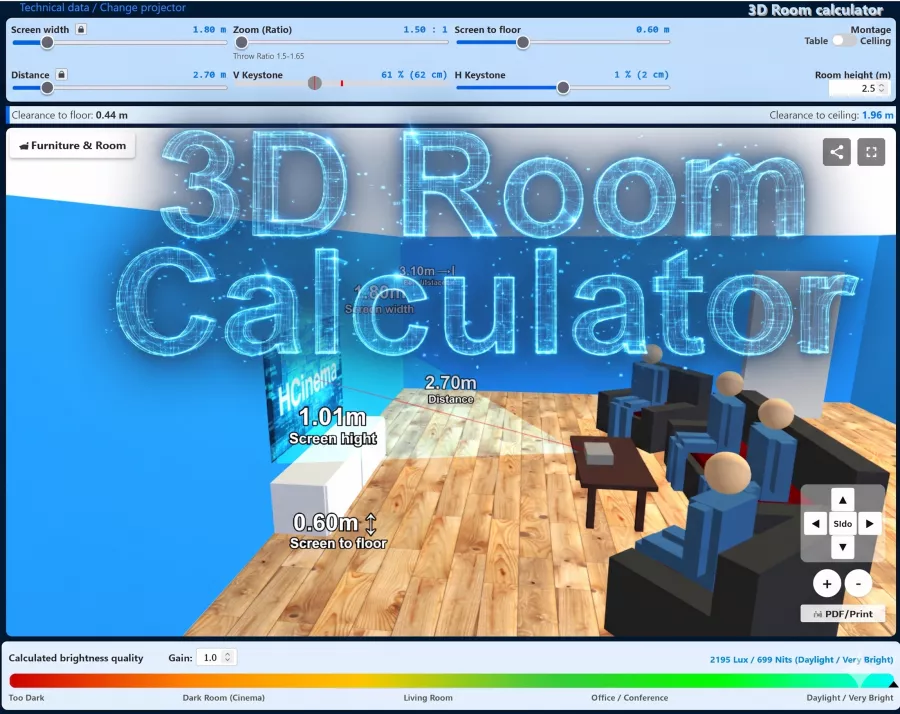
The basic data of the Mitsubishi HC100 includes 1300 ANSI lumens, a resolution of SVGA 854 x 480 as well as a contrast of 2000:1. According to Mitsubishi, the included lamp lasts up to 2000 hours. Regarding projection size, the value of 1300 ANSI lumens allows for an image width of up to 314 cm in darkened environments. In rooms with ambient light, the image width should be correspondingly reduced to a maximum of 209 cm. The projector was released in 2005 and is officially no longer distributed by Mitsubishi.
Display Type
1 x 0,55" 12 Grad DDR DDP2000 DLP Chip SVGA 4/3 Ti Digital Light Processing Chip
Ansi-Lumen
Projector
1300
Screen
433 Lux (200 cm Screen width)
Contrast
2000:1 full on/off
2000:1 full on/off
Black Level
0,6500 min. Lumen
0,217 min. Lumen
Offset
101% 77 cm over screen top edge →
SCREEN
+Projector
Resolution
SVGA 854 x 480
409.920 Pixel XGA 1024 x 768 compressed
Video Modes
PAL, SECAM, NTSC, HDTV 720p, 1080i,
Disc Recognition
DVD | HD Blu-ray (komprimiert) | 3D Blu-ray | 4K UHD Blu-ray
Application
Homecinema | Small screen width, rooms with very little ambient light below 50 lumens.
Light Source
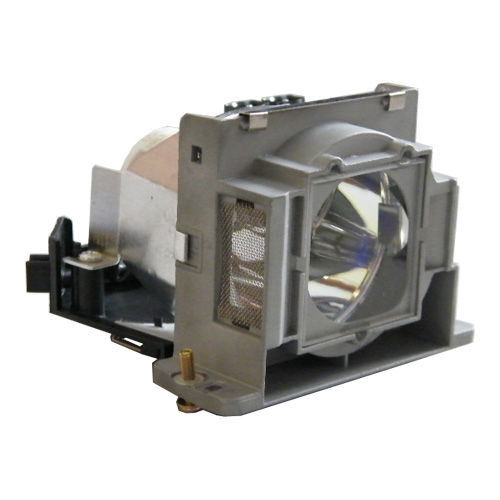
200 / 260W im Eco Mode Lamp Article Nr.: VLT-HC100LP
I bought the projector as a remaining stock with full warranty at a third of the former list price. I had been warned in advance by test notes such as visible color flickering, dull contrasts and color flickering and image shimmering, so I took a close and critical look at the picture quality at the dealer beforehand.
My requirements were:
Technology: DLP (no LCD)
Projection size: 120x69cm (16:9)
Resolution: TV, PAL/WPAL/576p (no HD!)
Good reproduction of SDTV
High contrast
Digital input: DVI or HDMI (with HDCP)
Ceiling mountable
Offset as large as possible
Fan noise max. around 30dB
Price max. 500 €
With these requirements in conjunction with the price specification, the choice was limited to a few options from the outset:
Acer P1165, Optoma DX609 or Toshiba ET10
The ET10 was unfortunately not available at the time, the other devices were computer or presentation-optimized and not designed for TV playback. The only other alternatives would have been second-hand sets with all the associated risks and costs (new lamp).
I was then offered the HC100, an old remnant model from 2005, with the statement that the set was optimally tuned and optimized for SDTV with excellent workmanship - as is known from Mitsubishi. The HC100 met my requirements almost completely. The presentation with SDTV resolution on a screen the size I wanted impressed me very positively compared to the other presentation projectors. The rainbow effect that has been criticized in many places did not bother me in the slightest. So I decided to go ahead with the purchase, especially as a return was possible if I didn‘t like it.
After the first test phase at home after mounting it under the ceiling together with the receiver, I can now draw the following conclusion:
The HC100 replaces an LCD TV without any problems. At the price of just under €400, it would only have been enough for a 26-inch set. Now I have a picture of 50 that I am completely satisfied with. Of course, you can‘t expect good quality with a projection of e.g. 2m picture width at SDTV resolution, but that wasn‘t required either:
Only the sound reproduction was, as expected, in need of improvement: a set of IPod active speakers from HAMA for €30 with bass booster, connected directly to the satellite receiver, solved the problem with flying colors.
To avoid the stand-by power consumption of the projector, satellite receiver and active loudspeakers, I then treated myself to a wireless switch with remote control so that I could conveniently disconnect all the devices from the mains.









 Freeze






 Mitsubishi Website
 Product Sheet english